Friday, May 19, 2017

Excalibur

Excalibur


"Merlin lives in our dreams now.
He speaks to us from there."
- King Arthur in Excalibur


King Arthur, one of the most enduring heroes of literature had not fared so well on the big screen. It wasn't even until Knights of the Round Table (1953) more than a half century after the birth of cinema that any serious attempt was made to tell his story.

In one of the latest takes, director Guy Ritchie brings his cockney gangster aesthetic to the Arthur legend in King Arthur: The Legend of the Sword. The film has been nearly universally panned by critics with the editing and lack of narrative flow being the most frequent complaints: "sloppily edited" (Salon.com), "fast cuts and jagged pacing... a brutal, bleedin' mess" (Rolling Stone), "narrative logic has no purchase" Slate "scattershot edits and on-the-fly plot descriptions" (Toronto Star).
While there have been some successful comedic takes (notably A Connecticut Yankee in King Arthur's Court, and Monty Python and the Holy Grail), only one serious film truly stands out - director John Boorman's 1981 film Excalibur.

Excalibur co-written by Boorman and Rospo Pallenberg draws inspiration from Thomas Malory's 15th Century version of the tales, Le Morte d'Arthur. The film is a lavish production featuring the full contingent of knights always clad in exquisite plate mail armor, and outstanding location photography in Ireland. All set to a soundtrack of Wagnerian opera and other classical greats. It's almost impossible to sit still when Arthur rides into battle for the first time, to the rousing strains of Orff's O, Fortuna.

The entire cast is top notch, including Nigel Terry as Arthur, Nicholas Clay as Lancelot, and Cherie Lunghi as Guenevere, but the real show-stealer is Nicol Williamson who gives a uniquely charming take on the old wizard Merlin. The supporting cast is a phenomenal who's-who of then-unknown actors like Helen Mirren, Liam Neeson, Patrick Stewart, and Gabriel Byrne!

Surprisingly, reviews were very mixed at the time. Roger Ebert called it, "a mess", and "a record of the comings and goings of arbitrary, inconsistent, shadowy figures". The New York Times called it pretentious, and legendary film critic Pauline Kael called the dialogue "near-atrocious" and said, "Excalibur is all images flashing by... We miss the dramatic intensity that we expect the stories to have". In other words, editing and narrative flow were among the biggest complaints.

But what a difference time has made. Today Excalibur is widely regarded as a classic, and the definitive screen rendition of Arthurian myth. Review aggregating site Rotten Tomatoes give it an 82% "fresh" (favorable) rating. Compare that to fellow British director Guy Ritchie's King Arthur: The Legend of the Sword which has a mere 28% (A.K.A. "rotten") rating. Maybe one day, decades hence, King Arthur: The Legend of the Sword will be seen as a classic too, but somehow I doubt it.

Friday, May 5, 2017

Troma's War 

"Bad" movies come in three basic varieties: movies that aren't great, but are fun (A.K.A. guilty pleasures), movies that are so bad they're good (A.K.A. the "Plan 9" type), and movies that are just a waste of time (A.K.A. boring). Over the years Troma Entertainment has been responsible for movies of all three types, making it hard to know just which Troma films are worth the time.

Troma's War (also known as 1,000 Ways to Die) falls into all three of those categories, depending on which version you end up seeing. The film was made when Troma was at it's creative and financial height - the mid to late 1980s, following two of Troma's best films, The Toxic Avenger, and Class of Nuke 'em High. Unfortunately, the original cut of the film was considered too graphic to receive an 'R' rating by the MPAA, and the film was heavily edited. The edited cut was again rejected, and the film was finally released in a version so heavily edited as to drop it into the "waste of time" category. Predictably it flopped and nearly sunk Troma with it.

The film is a parody of 80s action films, and the undercurrent of biting social commentary is definitely there. The plot involves an airline crash on a Caribbean island which is inhabited by a group of terrorists are planning to launch an attack on the U.S. The crash survivors soon run afoul of the terrorists, and eventually after learning of their plans, lead guerilla attacks to take them down.

Despite being one of Troma's best films, it was treated like a red-headed stepchild, one of Troma's more obscure titles for decades, difficult to find in video stores or big box bargain bins. Fortunately it lives on today and can be found for streaming on numerous sites - for free! The best version, however is probably the one available through Troma's own YouTube channel, as it is the best print and avoids pan-and-scan aspect ratio cropping, and some seriously bad sound issues and technical glitches some of the other versions have.

Friday, April 28, 2017

'The Defender' is like 'The Bodyguard' with Kung Fu

The Defender, original title The Bodyguard from Beijing

The Defender (1994)

What if the movie The Bodyguard had less Whitney Houston and more kung fu? It would probably resemble the film The Defender, whose original title was in fact, The Bodyguard from Beijing. 

It was likely inspired by that Hollywood film as it came out shortly afterward and the premise is essentially the same. A bodyguard (in this case from the capital of China) is sent to defend a beautiful, rich woman, and though he is focused on the mission and she finds his supervision oppressive, they eventually fall in love.

But The Defender not only has kung fu battles, it also has a lot more gun combat than its English counterpart, as well as a younger hotter Asian female lead.

Interestingly, despite being made years before Hong Kong was returned to mainland China, it's extraordinarily pro-P.R.C., with the competent bodyguard from Beijing, and the Hong Kong police portrayed as somewhat bumbling. And even the Hong Kong cops quote Chairman Mao. But despite this decidedly pro-mainland sentiment, the film was still banned by the Communist Party censors.

Like most of its ilk, it requires a lot of suspension of disbelief when it comes to the over-the-top wire work and other stunts (especially in the climactic fight sequence), but fans of Jet Li won't be disappointed.

Sunday, April 23, 2017

Reexamining 'Daredevil' (2003)

The 'Daredevil' fans would like to forget.

Reexamining 'Daredevil' (2003)

Most people would rather forget the 2003 film Daredevil, starring Ben Affleck in the title role, which isn't hard to do - it's a very forgettable film. Despite only having come out about 15 years ago, I realized as I recently re-watched it that there were films I saw over 30 years ago that I remember better than this one.

So when the questions comes up, "is it better or worse than you remember," the answer is yes. It's both.

First let's talk about what Daredevil does right. The first half hour of the film is actually quite good. The film opens with Daredevil already a fully fledged crime fighter, and his origin is rapidly, and effectively told in a flashback. There are some changes made to his origin story - instead of a radioactive canister flying by his face, it's a chemical spray from a ruptured drum that blinds him, and it doesn't fall off a truck, it's hit by a forklift swerving to avoid Matt himself who's running from where his father was acting as a mob enforcer on a dockyard. The whole sequence actually makes a lot more sense than even the original comic book version of Daredevil's origin, and it remains the best version of the story ever put to screen.

Other things Daredevil does well includes the red leather Daredevil costume, which is better than even the most recent Netflix Marvel's Daredevil TV series version; the excellent martial arts fight scenes (choreographed by some of the best specialists in Hong Kong film industry); and the excellent CGI representation of Daredevil's radar sense that allows the viewer to see the world as Daredevil "sees" it.

A special shout out needs to be given to the late Michael Clarke Duncan, who is the only actor that hasn't been miscast here. I'm going to go out on a limb here and say that his portrayal of The Kingpin is better even than the more recent Vincent D'Onofrio small screen version, though he isn't given nearly as good material to work with, and barely any screen time to develop it. His swaggering hoodlum that started as a mob enforcer from the Bronx and worked his way to the top of New York's criminal underworld is again both faithful to, and an improvement upon the comics' Kingpin of Crime.

That brings up the casting, which is the first big problem with the film. As previously mentioned, nearly everyone here is miscast. While there's a lot of shade thrown toward Ben Affleck as Daredevil and while he's not ideal, he's not too bad either. His Matt Murdock is actually kind of believable - good looking, charming, exactly the kind of guy you think of when you think of an Ivy League New York frat boy turned lawyer. It's the rest of the supporting cast that's wrong. Joe Pantoliano seems lost in the role of Ben Urich; Ellen Pompeo might've been a good Karen Page, but we don't really know as she's given exactly one line in the whole film; and Jennifer Garner is so unlike the assassin Elektra as to be laughable. Other parts seem to have been doled out to people's buddies like Jon Favreau and Kevin Smith. And then there's Bullseye...

Bullseye was always one of the most interesting Daredevil villains, a former Major League Baseball pitcher whose sole superpower was the ability to turn nearly any object into a lethal weapon due to his knowledge of anatomy and deadly accurate pitching arm - the ultimate silent but deadly assassin. But in this film he's an Irish blabbermouth with a bullseye scar on his forehead played by Colin Farrell who mugs his way through the entire film in a cringe-worthy performance every time he's on screen. As soon as he shows up the film goes completely off the rails.

But casting isn't even the biggest problem with the film. It seems like 20th Century Fox wanted their own version of Tim Burton's Batman, and would stop at nothing to get it. There is a needless and intrusive gothic style imposed on the proceedings with Murdock living in a gargoyle-encrusted penthouse and sleeping in a coffin (yes, really). At one point during a climactic battle inside a church, a flock of bats flies out of a pipe organ for no good reason but to distract the bad guy at a crucial moment. 

The twin problems of under-developed script and over-edited final cut result in a disjointed film where characters just show up for fights as if they had been pre-arranged on "X" rooftop at "Y" hour. Little attention is given to Daredevil alter ego Matt Murdock's role as defense attorney of Hell's Kitchen's underprivileged. The whole thing comes off as the bland, forgettable action movie that's representative of everything that was wrong with comic book movies prior to 2008 (The year The Dark Knight and Iron Man came out).

The good news is that there's a Director's Cut of the film widely available on DVD and Blu-Ray that goes a long way toward addressing some of these problems. There's an entire subplot involving Nelson and Murdock defending a murder suspect that adds mystery and courtroom drama, the awkward love scenes between Matt and Elektra are removed, and the overall tone is darker and more violent. The bad news is that even this much improved Director's Cut can't completely redeem the film. It's no longer awful, but it's still largely forgettable.

Friday, April 14, 2017

The War Game

The War Game

It's hard to believe that while the world has lived with the threat of nuclear war for over 70 years, yet the actual results of a nuclear exchange are rarely shown on film. Perhaps it's not so surprising when you consider that the powers-that-be do not like the citizenry to be reminded of either how complicit they are in risking such a situation, or how woefully inadequate they are at dealing with the aftermath of such a situation. 

Case in point, The War Game, a documentary directed by Peter Watkins for the BBC in 1965. Despite being produced by the BBC, it never aired as it was immediately banned by the BBC. The ban has been so long-lasting that even at the time of this writing, more than a half century later, it is still a hard film to track down - despite having won an Academy Award!

The made for American TV film The Day After, itself incredibly controversial and highly censored by the government and the network, made two decades later in the 1980s, is the only other really notable film of its kind that stands along side it, and it too is very difficult to find.

The War Game packs a punch without ever becoming ponderous, thanks to a 45 minute run time. It is one of the first documentary films to use the now commonplace dramatic re-enactment technique to visually illustrate its what-if scenario about a nuclear strike in the south of England.

Although we now know even a limited nuclear exchange would certainly be far worse than even this film depicts, it's still a very relevant document.

Wednesday, April 5, 2017

Hidden Figures

Hidden Figures

 Until fairly recently nerds really didn't get that much attention in film. If present at all, it was usually as comic relief in some teen comedy best forgotten. Rarer still was (and to some degree still is) the depiction of female nerds, and African-American female nerds are so rarely seen as to be virtually unheard of. This is why this movie, about a group of female African-American mathematicians who worked for NASA in the 1960s is called Hidden Figures.

It resembles other mid-20th Century nerd biopics like A Beautiful Mind and The Imitation Game, Hidden Figures deals with gravely misunderstood and mistreated individuals whose work was critically important to the governments of the Western powers. But unlike those other films, Hidden Figures deals with an entire group of women who worked behind the scenes at NASA rather than just on one individual - focusing on three notable members of the group.

Entertaining and enlightening without becoming ponderous, Hidden Figures is a good reminder that The Right Stuff wasn't limited to just astronauts.

Monday, April 3, 2017

Kedi

Let's face it, cats are the pet of choice among nerds and geeks. They are intelligent and largely self-sufficient. It's why cat memes rule the Internet.

So a feature length documentary about cats is such a no-brainer that one wonders why it took so long. Kedi (Turkish for "cat") is a documentary about several cats in Istanbul.

Since at least the medieval period, cats have been revered in this city for there ability to keep the rodent population in check. There history undoubtedly goes back much farther in the region, though. They are mentioned in the Quran, with the Prophet Mohammad himself said to have fed one, and of course we know cat worship existed in ancient Egypt. The domestic cat is descended from wild cats in that part of the world. Anyone who has ever been to Istanbul can tell you that there are lots of cats around and the entire community feeds and waters them. World leaders come to pet the cat Gli who lives in the world's most famous mosque, Hagia Sophia.

Kedi focuses on telling the story of seven of these cats. Cameras follow the cats around often at cat-level. There is no narration; no judgements or political stances taken, no strongly pushed point-of-view from the filmmakers. Just video of cats, and interviews with numerous people who feed, shelter and give veterinary care to the cats. The film also features some spectacular aerial footage of the city as well.

Overall Kedi is a delight for cat lovers. As of this writing it hasn't found a wide release, just touring the festival circuit, but if you get a chance it's worth seeing if you're fond of felines.

Monday, February 6, 2017

Geek Valentine's Day

Formulaic Hollywood Rom-Com, But...

Every Valentine's day geek guys have to suck it up and watch a boring, predictable romantic comedy with their beau. So if you're going to have to suffer through it, allow us to suggest Failure to Launch.

Now, make no mistake Failure to Launch is as inane, predictable, and unrealistic as the rest of its ilk, however it differs in one major respect: the guys are geeks; extremely idealized female fan-service type geeks that look like Matthew McConaughey, but geeks nonetheless. They love paintball, videogames, and don't care that they live in their parents' basements.

Matthew McConaughey plays Trip (O.K., so they are pretty Preppy geeks), who lives with his parents (Kathy Bates and Terry Bradshaw who practically steal the show). The parents hire Paula (Sarah Jessica Parker) who is an "interventionist" to help them get him out of the house.

The supporting cast really helps carry the film. In addition to Bradshaw and Bates, comedians Rob Corddry and Patton Oswalt play the other two "basement" guys, and geek girl extraordinaire, Zooey Deschanel, plays Paula's roommate Kit.

And while there's all the standard Rom-Com cliches here, there's a twist on the single most annoying convention of the genre: the pivotal scene where the guy has to grovel and profess his undying love to get the girl back. 

So we're not recommending this as a genuinely good movie, but rather one that's bearable enough to get from the Netflix to the Chill on Valentine's Day.

Monday, January 23, 2017

Advise & Consent

Advise & Consent

Some movies don't live up to there reputation. In this time of transition I'd love to be able to recommend Otto Preminger's thriller Advise & Consent, about a U.S. President's nomination for Secretary of State who has a secret past, and the political machinations surrounding the Senate approval hearings of his appointment.

Preminger's films often pushed the envelope, dealing with issues that had been taboo in Hollywood's Golden Age, and a number of them hold up well today. Advise & Consent, however isn't one of them. While it was no doubt quite revolutionary to see the U.S. Congress depicted in such a stark, realistic light, a far cry from the Mr. Smith Goes to Washington idealism of the time, it's no longer a novelty in that regard. While the first half of the film builds up some tension, that all seems to dissipate in the second half as it's all bogged down in talk. In its day, maybe it could have sustained the audience's attention for the long haul, but in a post-West Wing, post- House of Cards world it just too dull.

Tuesday, December 27, 2016

Die Hard 2 Dies Harder, But is That a Good Thing?

Die Hard 2: Die Harder review.

Making a sequel to Die Hard is a tall order. I mean what are the odds that off-duty police officer John McClain is going to run into terrorists twice in his life? Well they didn't go with the obvious and come back for revenge in Die Hard 2, instead he runs into all new terrorists, coincidentally also at Christmastime. But the coincidences don't stop there. Again his wife Holly is in danger as the terrorists have disabled the airport where her flight is supposed to land, and guess who else happens to be on the flight? Richard Thornberg, the pain in the ass reporter from Die Hard 1.

O.K., so let's forget about all that and just try to go with it. The movie pokes fun at itself a bunch for the incredible coincidences. But there's another problem here - the characters makes a bunch of leaps in time and knowledge for plot expediency. For example, at one point McClain and an ally discover that the bad guys are holed up in a neighborhood adjacent to the airport. The whole film involves a deadline because planes are circling the disabled airport and running out of fuel. Somehow seconds later McClain and friend have searched 12 houses and narrowed down the place the bad guys are holed up - by themselves. They phone the airport tower and the police captain there doesn't say anything about who he's talking to or what about, but the army major who's in charge automatically knows and takes the address from his hand. Seconds later the soldiers who were in camouflage fatigues, are now in winter gear and on their way. I could go on, but you get the idea.

There are also, of course the usual physics-defying stuff, but thankfully most of it is believable... until the final end of the bad guys which really stretches credibility.

All of this may sound like Die Hard 2 is a terrible movie. It's not. In fact by early 90s action movie standards, it's actually pretty good. All the believe-ability issues are with the situation, not with the actual conflict. This is probably because rather than write a made-for-Die-Hard screenplay, they adapted an existing thriller novel, 58 Minutes, for the screenplay.

Die Hard was a truly unique action movie, and in some ways almost 30 years later it has yet to be equaled, so we have to cut any potential sequel some slack. But if you just want an escapist shoot-em-up with some characters you already know and love, Die Hard 2 fits the bill. And c'mon, how many Christmases in a row can you just watch the original Die Hard? Maybe Die Hard 2 deserves an occasional holiday viewing too.

Monday, December 26, 2016

Because... why not?

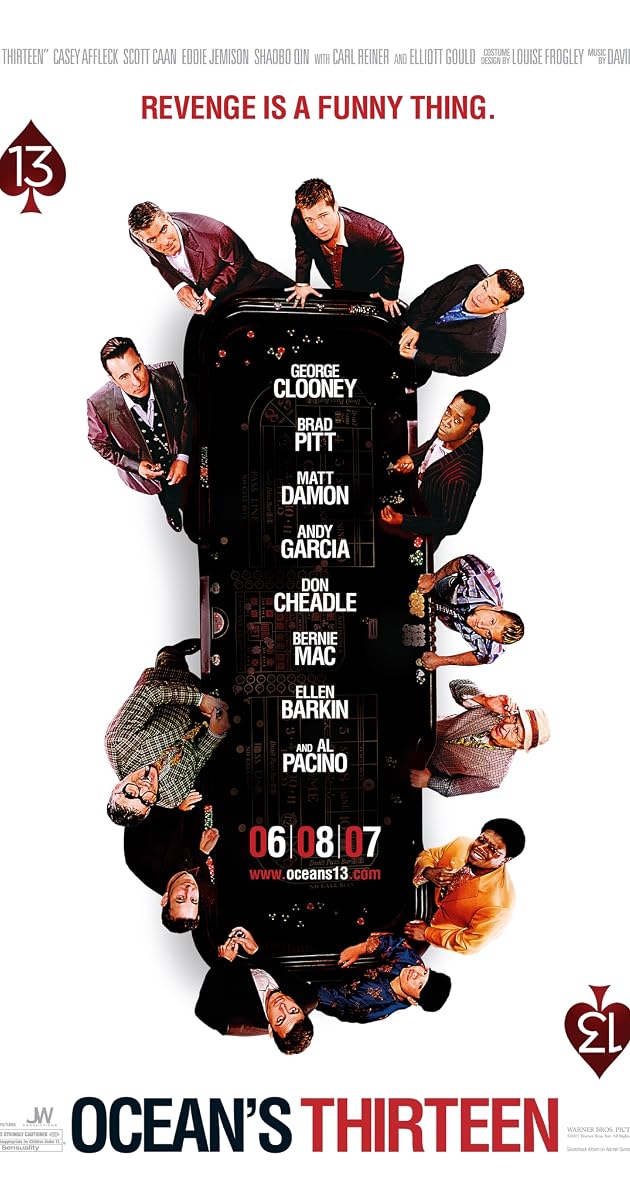
Who would've thought that an Elvis-like film vehicle for the Rat Pack would spawn one of the most successful film franchises more than 40 years later?

Nobody, least of all director Stephen Soderbergh, is ever likely to claim that the Ocean's Trilogy is some grand artistic achievement. It's a series of heist films driven more by the charismatic stars than by the story lines.

So why see Ocean's Thirteen? Well if you didn't particularly care for the previous films, there really isn't a reason to. If, however, you like the formula of the last two, you'll like this one too. In fact, Ocean's Thirteen is actually a tad better than the previous film, Ocean's Twelve in that that film just upped the ante by adding more heists, but this film instead doesn't try to add more heists, but downplays heists altogether. Yes, there is a diamond heist, but it really isn't the focus of the film - instead Danny Ocean's cohorts this time are out to avenge a wrong done to their friend Reuben by ruining the opening night of a casino owned by the hotel mogul that ripped Reuben off which precipitated a debilitating heart attack for poor Reuben.

As usual Ocean's plan is needlessly complicated, and overly reliant on luck, but really it's not the kind of film that's meant to be overly scrutinized either. You either like the slick, melodramatic, crime dramas, or you don't. If you do, you won't be disappointed with Ocean's Thirteen.

Saturday, December 24, 2016

Get Santa

Get Santa


Once upon a time it seemed like there wasn't a lot of choice when it came to Christmas movies. You took your pick between watching Miracle on 34th Street, It's A Wonderful Life, or some version of A Christmas Carol. And for genre fiction fans, it's not like there was a derth of fantasy films when you consider that any film involving Santa and "elves", is by definition a fantasy film. It's just that the best holiday films were the ones that left out the fantasy elements entirely and focused on action and drama. Films like A Christmas Story, for example.

Beginning in the 1980s with films like Die Hard, Hollywood almost accidentally discovered that with the rise of home video, the perennial returns on holiday-themed films were a good investment. Now we get one or two good films every couple years. So it's easy to overlook some of the smaller genre films. In the past we've reviewed Black Christmas, Santa Claus Conquers the Martians, and Rare Exports. This year we take a look at a far more mainstream film that you may have missed: Get Santa.

Get Santa is an apologetically family film ala Home Alone or Jumanji. You know exactly what you're getting with a plot that can be summed up like this: Santa crashes his sled and winds up in jail. It's up to one little boy and his ex-con dad to break him out and save Christmas. Wacky high-jinks of course ensue. But unlike a lot of holiday fare, the sentimentality is tempered with an offbeat sense of humor  (at one point Santa shoots a semiautomatic poop-gun at the pursuing police).

It's sad that a film that was meant to console and comfort was the last film Tony Scott produced before he tragically took his own life in 2012. And, while some jokes fall flat, there's still more hits than misses, and the misses can be more easily forgiven because the film genuinely has a warmth to it that a lot of pre-fab Christmas films just don't.

Wednesday, December 21, 2016

Dark Skies


Close Encounters of the Third Kind was perhaps the first film to deal seriously with the U.F.O.  / alien abduction phenomenon. That film had a strong dose of thriller-suspense to it. So it was only a matter of time before someone came along and took the next logical step: taking the same premise and making an outright horror movie out of it.

Enter: 2013's Dark Skies. Dark Skies takes the haunted house concept and substitutes aliens for ghosts or demons. In fact if you took Dark Skies and swapped the alien manipulation for demonic possession, there would be little to distinguish it from Paranormal Activity.

The film effectively builds an eerie tension throughout, and all four principal actors (Keri Russell, Josh Hamilton, Dakota Goyo, and Kadan Rockett) do an excellent job at portraying a family legitimately being terrorized by an unknown enemy.

The only problem is that Dark Skies spends an hour and fifteen minutes of its hour and thirty seven minute run time building the suspense and then less than fifteen minutes trying to pay that off in the final fifteen. It can't help but feel like a bit of a letdown.

If all you are looking for is scares, Dark Skies is there for you. If on the other hand you're hoping for a film that finishes as strong or it began, you're likely going to be disappointed.

Thursday, November 3, 2016

Duck, You Sucker, Sergio Leone's Forgotten Film 

Most people know Sergio Leone for his "Dollars Trilogy", three films that starred Clint Eastwood, A Fistful of Dollars, For A Few Dollars More, and The Good, the Bad, and the Ugly. Fewer people are familiar with his "Once Upon A Time Trilogy": Once Upon a Time in the West, Once Upon a Time... Revolution, and Once Upon a Time in America.

Of all his films, the middle film of the Once Upon a Time series, Once Upon a Time... Revolution, released in the U.S. as A Fistful of Dynamite, before being given the title Leone preferred, Duck, You Sucker. Is perhaps the most overlooked Leone film. Set in 1913 Mexico, it tells the story of I.R.A. terrorist John Mallory and Mexican Bandito Juan Miranda, who team up to pull a bank job and become unlikely players in the Mexican Revolution.

While the narrative is far murkier than previous and subsequent Leone films, that's part of the film's charm. Whereas Leone films (and Spaghetti Westerns in general) tend to have characters whose motivations are somewhat concealed, Duck, You Sucker takes things a step further as the John and Juan's paths cross, diverge, and recross through a story where not everything is explained, making it feel much more like real history than mere popcorn theater.

If you really want to sink your teeth into a prime Spaghetti Western that doesn't star Clint Eastwood, this would be a good film to check out.

Saturday, July 26, 2014

Mississippi Burning - *****

If you look at any film guide from the period, Mississippi Burning usually rates about 3 out of 5 stars. I'm not sure why this film, which was nominated for a number of Academy Awards (including a win for best cinematography), was generally though of as just a bit above average by most critics.

Whether it was the controversy over liberties with history (as the director often points out, it's a dramatization based on real events with fictitious characters, not a documentary), or it just got lost in the crowd in a year that also gave us Bull Durham, Die Hard, Rain Man, Who Framed Roger Rabbit, and the even bigger Willem Dafoe film, The Last Temptation of Christ, but whatever the case, it was clearly an oversight as Mississippi Burning is now, justifiably considered a classic.

There are many strong performances here, including Brad Dourif as a racist deputy, and Frances McDormand as his wife, but the film hangs on the two key leads played by Willem Dafoe and Gene Hackman, two actors who can almost always be counted on to deliver electrifying performances.

The film deftly weaves almost every emotion in the book together in a tale about the FBI's investigation of the murder of Civil Rights activists in 1964 Mississippi. It is a detective story a little reminiscent of the 60s film In the Heat of the Night, with a northern detective paired with a (in this case former) Southern Sheriff, but in this case the tale is rooted in truth. Where it takes liberties with the facts, it does so in the interest of conveying the emotions of the time, and thus remains a relevant and powerful piece of film making.

Wednesday, July 16, 2014

Madhouse - ***

Madhouse is like every other Vincent Price horror film, which is to say it has a mediocre script buoyed by Price's performance, meaning on a scale of 1-10 it would rank about a five or six.

But, Madhouse has a couple extras going for it that make it just a tiny bit more enjoyable. First, Price's co-star is the one and only Peter Cushing, and the scenes they share are excellent, even when they aren't talking about anything consequential.

Second is the gimmick that Price and Cushing are playing aging horror movie actors, in other words, characters like unto themselves. This not only adds believability, but allows the producers to throw in a bunch of clips from old Vincent Price films as if they were showing clips from his character Paul's past work. For the horror movie buff, that means the chance to pick out actor and movie references throughout.

If you've seen no other Vincent Price horror films, I wouldn't recommend starting with this one - not just because it's not one of his best, but also because the funnest part of this movie are its references to all his other movies. In other words, watch this after you've seen the best of his 50s and 60s work.

Sunday, July 13, 2014

The Royal Tenenbaums - *****

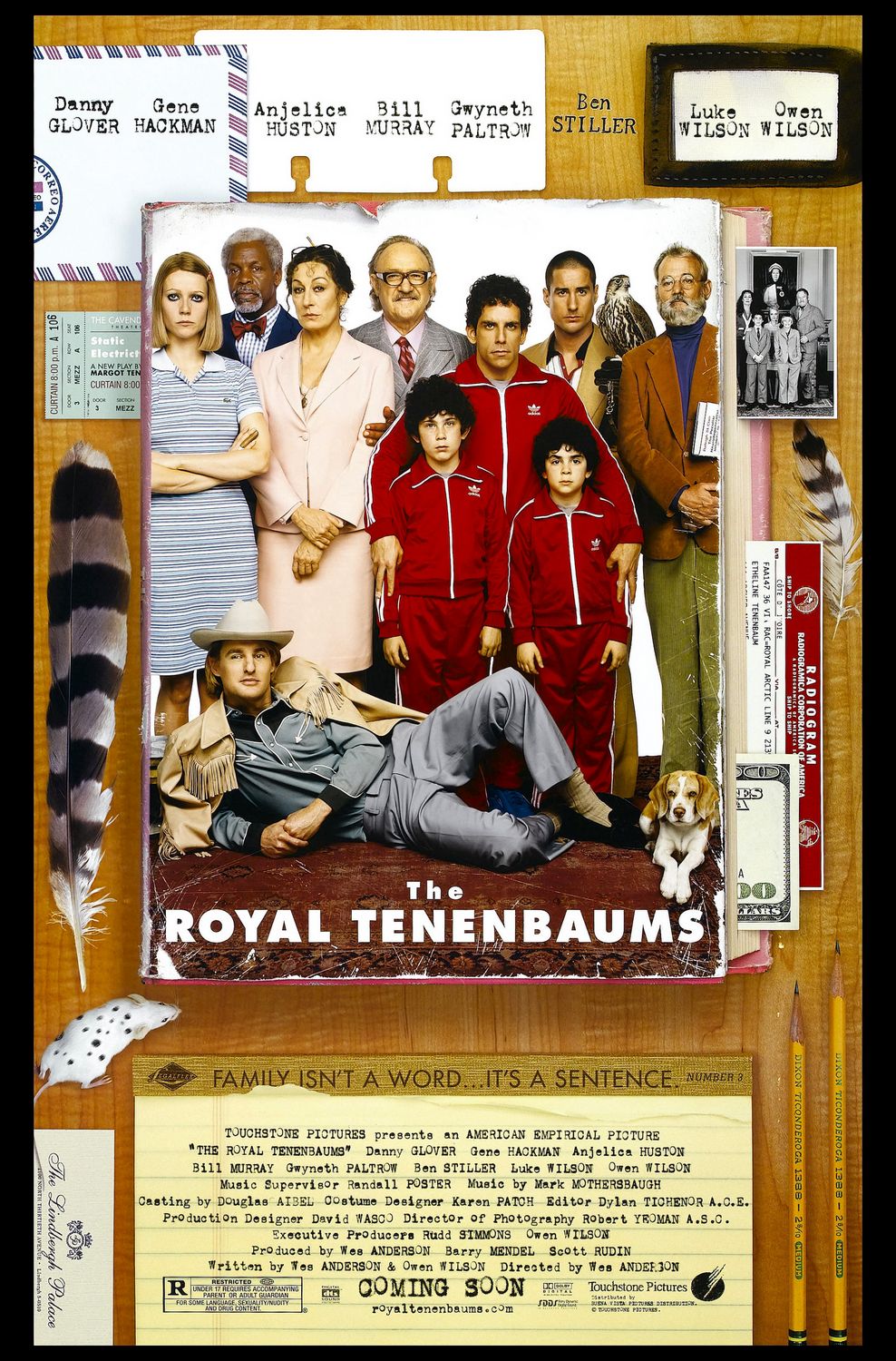
Before The Royal Tenenbaums was even made, I knew that Wes Anderson was a unique voice on the cinematic landscape, even if I wasn't quite sold on the cult popularity of Bottle Rocket and Rushmore. To me it seemed that Anderson was mixing a certain amount of populist storytelling with an obvious use of kitschy retro styling in a calculated-to-appeal to Generation Y approach that I found simultaneously entertaining and eye-rolling.

But then came The Royal Tenenbaums, and everything just clicked. Despite all the accolades for later efforts (like the recent Grand Budapest Hotel), The Royal Tenenbaums, to my mind is Anderson's greatest film creation to date.

A lot of the credit goes to the ensemble cast. In Luke Wilson, Gwyneth Paltrow, Ben Stiller, Angelica Huston, Bill Murray, Owen Wilson, Danny Glover, Alec Baldwin, and especially lynchpin Gene Hackman (who is always outstanding in every role he plays); Anderson has assembled a cast of some of the most underrated dramatic actors in Hollywood around the turn of the millennium - either because they were still up-and-coming, or in the case of the more seasoned veterans, largely overlooked actors whose greatest successes were from the 70s and 80s. In both cases, the talent was eager to prove themselves, steal scenes and chew the scenery, which works well with Anderson's everybody's-quirky-and-nobody-is-the-straight-man type storytelling.

But The Royal Tenenbaums hits what Bottle Rocket and Rushmore were aiming for. By acknowledging from the start that the titular Tenenbaum family is not normal, the lack of a straight man in a major role as a point of reference does not hinder this film the way it does with those prior films.

Like all Wes Anderson films, The Royal Tenenbaums demands that the audience sit tight, give up control, and observe events as they are spoon fed, the story by a narrator (in this case the affable Alec Baldwin). But if you are prepared to accept that, it can be quite engrossing for all its contrived glory.

Sunday, June 22, 2014

Captain America: The Winter Soldier ****
Captain America: The Winter Soldier may not be the perfect Marvel movie, but it is the best of this year's crop, and possibly the best solo Marvel superhero (non-team) movie so far.

Why? Because Captain America: The Winter Soldier has learned what all superhero films should learn - that the superhero doesn't make the movie, it should first be a good story - science fiction, mystery, thriller, whatever - and then the superhero should be placed in that story. Too often superhero movies are simply 'origin' stories for the superhero and they fight a supervillain - the end. Captain America: The Winter Soldier is actually a thriller, specifically, a spy thriller (ala James Bond), where the protagonist happens to be Captain America. That's the difference, and what a difference it makes.

Could it be better? Yes, there's still a lot of room for improvement here. Robert Redford appears as a member of a covert organization (SHIELD) that is compromised from within (hmmm... where have we seen this before *cough* Three Days of the Condor... *cough* Spy Game), and from the get-go, you just know he's going to turn out to be the bad guy, but O.K.

Also the 'comic book physics' get pushed a little too far at times. Captain America should be able to do superhuman things to a point, but he really isn't Superman, just an augmented human. Not only are some of the things a little too physics defying, but by making him such an uber-badass all the time it tends to paint him into a corner. For example, at one point he surrenders when he's surrounded by a group of armed men pointing guns at him. That makes sense. But what doesn't make sense is why he's surrendering to a group of armed men pointing guns at him this time, when all throughout the film he's taken on groups of them, including an aircraft shooting at him - with him just dodging the bullets, and now suddenly he thinks he can't do it again, despite having done it just an hour ago?

But those things can be overlooked given the smooth forward momentum of the entire story. Large parts for Nick Fury, Black Widow, and Falcon also really enhance the feeling that is a story about a world of super spies (Hell, even Batroc 'zee leeper' makes an appearance as a terrorist), and not just a Captain America saves the world type 'superhero' film.

That does mean sacrificing a little of the patriotic American-centric nature of the character (hey, you knew they were going to do that anyway, given the reliance of the studio on foreign market success), but at least it does include some commentary on the state of the U.S., with a subtext hinting at the NSA bulk data collection, and the controversial drone program downplayed but evident.

Captain America: The Winter Soldier has raised the bar a little for superhero movies going forward, let's see if its successors are up to the challenge.

Friday, June 20, 2014

The Wicker Man (2006) **
(and also ****)

I've given this film both a two star rating (and that's being generous) for overall quality, and also four stars for kitschy fun, because this attempt at remaking the 1973 cult classic of the same name goes so badly off-track that it becomes one of the most unintentionally hilarious bad films of the past decade.

Hollywood remakes in general tend to go poorly, especially remakes of classics, but there are so many missteps here it boggles the mind. The original was an English film and contrasted a believable stiff-upper-lip modern Brit encountering a pagan cult still practicing ancient Celtic rites in the remote islands off the coast of Scotland. As such, it was completely believable. This version however decided to relocate the cult to the U.S. of course, which automatically stretches the credibility. But not somewhere in, say, New England, oh no, it was set in the islands of the Pacific Northwest, a place Hollywood loves to shoot for budgetary reasons.

But taking the ancient Celtic cult about as far away from the British Isles as possible in the U.S., save maybe Alaska, was just the beginning. The lead role was given to none other than Nic Cage, whose (ahem) limited acting range have helped make bombs out of a lot of other genre pictures. Here Cage does not disappoint, turning in a performance so wooden that you might think the title refers to his character.

Cage plays police officer Edward Malus, who goes to the island to investigate the disappearance of a girl who looks identical to a girl who he failed to save in a car crash a few months earlier. Despite near constant flashbacks, to that scene, it's never explained, with even such details as who was driving either vehicle left completely unresolved.

These annoying, persistent flashbacks aren't the only intrusive and unexplained scenes though. Soon Malus starts having flashbacks to things that never actually happened in what is obviously a desperate attempt by the filmmakers to inject some sort of visual shock value into the otherwise lifeless film. In one particularly funny sequence, Malus rescues a drowned girl only to flashback to not having rescued the drowned girl, before flashing back to having rescued the drowned girl, before showing in the present that he hasn't in fact rescued anyone - all through a series of jump cuts. Despite this and other attempts at shock value, this PG-13 film is actually tamer, with nothing to rival the pagan debauchery of its predecessor of more than 30 years!

Eventually Malus actually has to don a bear costume (that is funnier than the 'pagan' outfits Dan Akroyd and Tom Hanks wear in the comedy remake of Dragnet) in order to infiltrate one of the cult's sacred rites.

There's so much more I could go into, but I'm going to leave it at that and say grab some beers and some buds and check this out (the theatrical version is preferred over the 'unrated' version for maximum lulz), you will be rolling on the floor with laughter before the first ten minutes are up!

Thursday, June 12, 2014

The Artist *****

It's kind of ironic that a tale of the Golden Age of Hollywood like this could only be made outside of Hollywood today - by the French no less.

But it kind of makes sense, when you think about it. It's a day and age where Hollywood is only interested in producing enormous budget tent pole films; and Hollywood doesn't seem to have a lot of respect for its own history, judging by all the sequels and reboots that care more about CGI than story.

The French however have a long history of appreciation for the art form of cinema (they can after all make a strong case for having originated the medium). And that appreciation shines through in spades in the film The Artist.

The Artist tells the story of two actors, one seasoned leading man 'George Valentin', and the other rising starlet 'Peppy Miller', in the early days of motion pictures. The two have a rocky romance complicated by the fact that the man's career is thrown into a tailspin with the advent of 'talkies' just as the woman's begins blossoming. No doubt inspired by similar events in the lives of real stars of the silver screen.

But, The Artist, does more than tell a story set in that time period, it actually adopts the style of the period, being entirely black and white and with musical accompaniment replacing dialogue. More than that, though, the film actually emulates the storytelling form of the period, there is a human-ness in Jean Dujardin's George Valentin that is reminiscent of the kind of character Charlie Chaplin or Buster Keaton might play, a good-natured fellow buffeted by fate.

The Artist is one of the best films about the Golden Age of film ever produced, and is highly recommended.